
The second edition of the Spaghetti Bridge Competition at UBT was organised in collaboration with Prof. Driton Kryeziu and in direct coordination with the Dean of the Faculty of INI, Prof. Visar Krelani, with strong institutional support from UBT and valuable contributions from the competition sponsors.
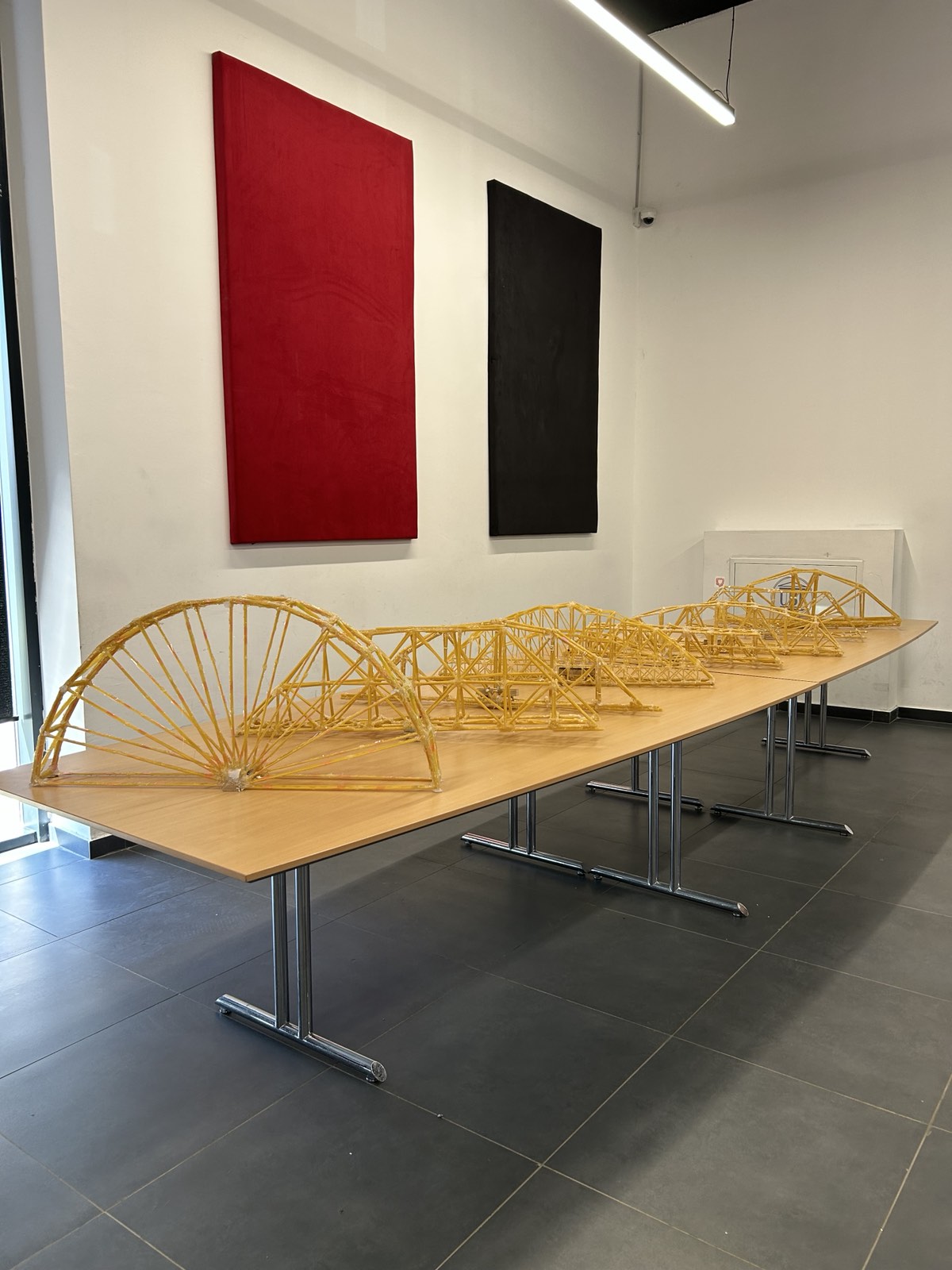
Beyond two memorable days of creativity, collaboration and enjoyment with the students, the event was defined by the participants’ remarkable and tireless dedication. The result was a diverse collection of bridges, each with its own structural idea and identity (Figure 01).
Which bridge won—and why?
Beyond the enjoyment of the event, an important engineering question remains: which bridge won, and why? The boundary conditions were identical for every participant. The material—spaghetti—was the same, the point of force application was fixed, and differences in structural weight were accounted for through the Success Ratio, defined as the ratio between the Breaking Force and the Weight of the Structure.
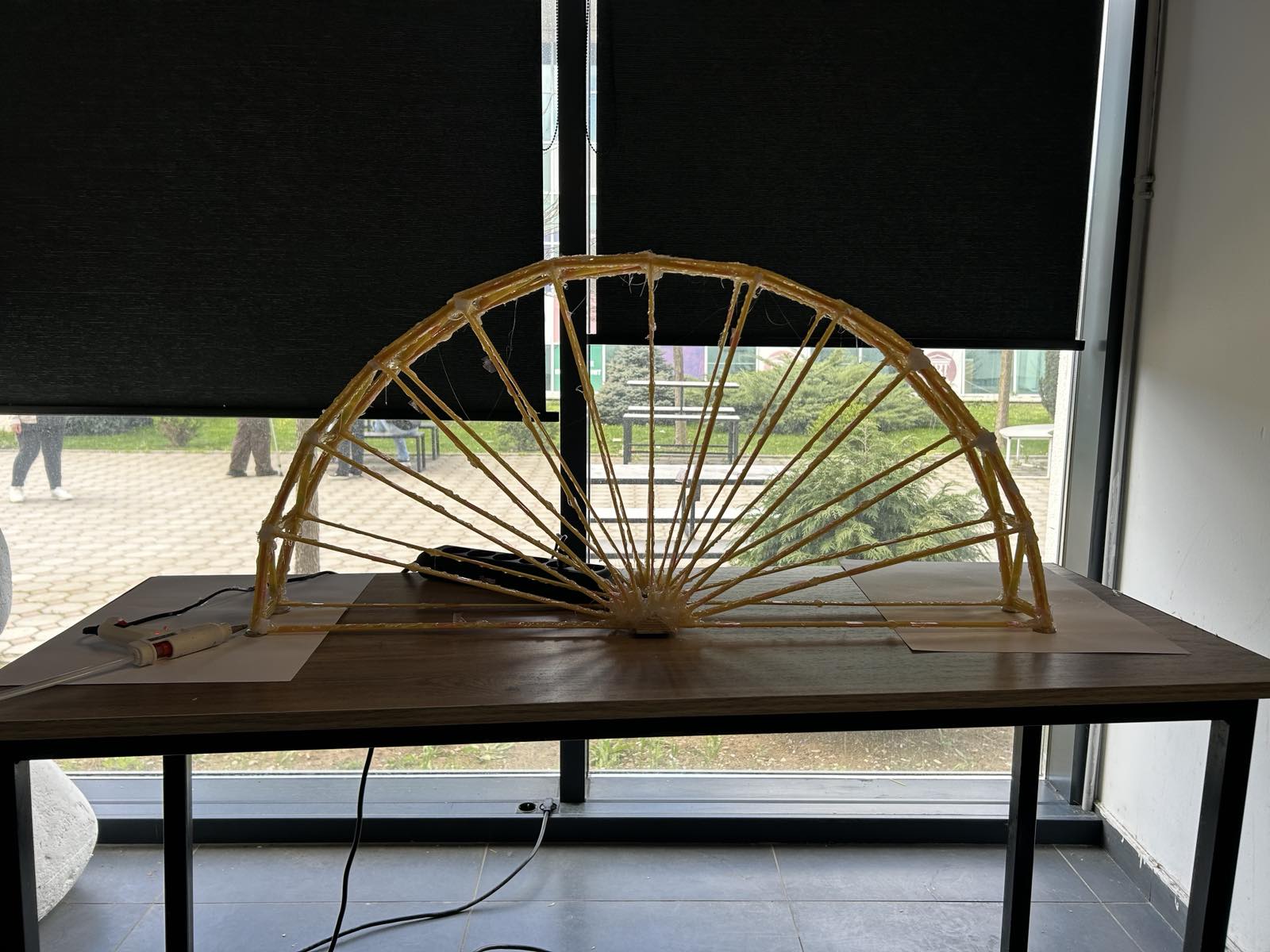
The winning bridge was an elegant semicircular arch formed from relatively slender profiles (Figure 02)—a solution that might not immediately impress an intuitive observer. Yet it won by a substantial margin. Which parameter was responsible for that performance?
Shape is the decisive parameter.
Essentially, the bridge won because of its Shape—its Geometry—the decisive parameter in Structural Engineering and far beyond it. Its form creates an almost ideal and natural flow of forces through a duality between Compression and Tension. Indeed, these two force states are sufficient to establish the conceptual basis of virtually any structural system.
Structural Optimization
The load path made visible.
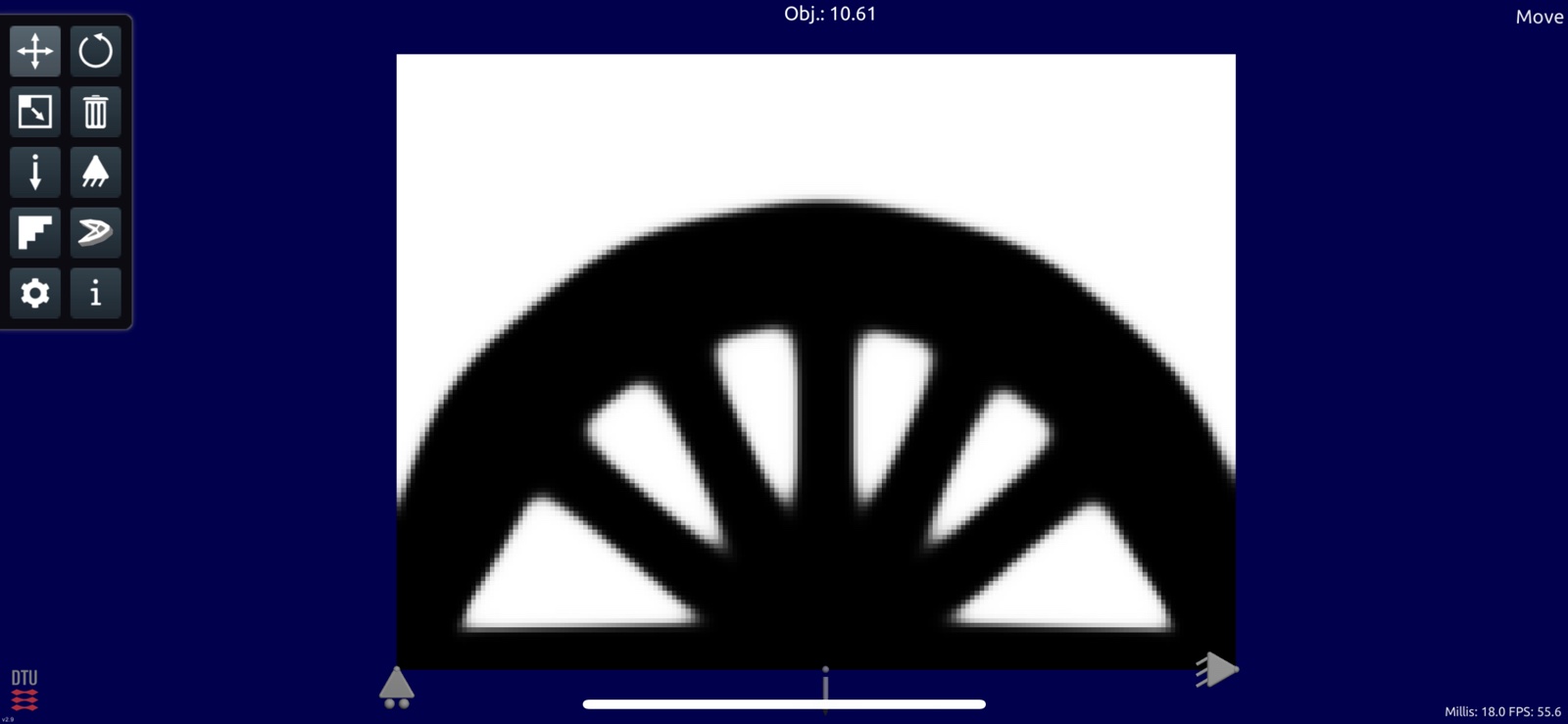
To move beyond the conceptual and philosophical reading, and to understand a load path that may not be intuitive to every observer, we can turn to Structural Optimization. Consider a simple rectangular design domain subjected to the same boundary conditions used in the competition: the same applied force and support positions. After optimization, the resulting material distribution closely reproduces the geometry of the winning bridge (Figure 03).
The applied force and the supports lie along a common line. To maximize resistance, the internal lever arm must therefore be increased. The arch provides this depth and works efficiently in Compression, while the bottom tie carries Tension. The remaining ties transfer load and activate the arch–tie duality.
Even a small change in the force position or support arrangement would alter the force flow and could cause this same geometry to lose its advantage—or “fail.”
Competition announcement · 2025 archive
2nd Spaghetti Bridge Competition – Apply Now!
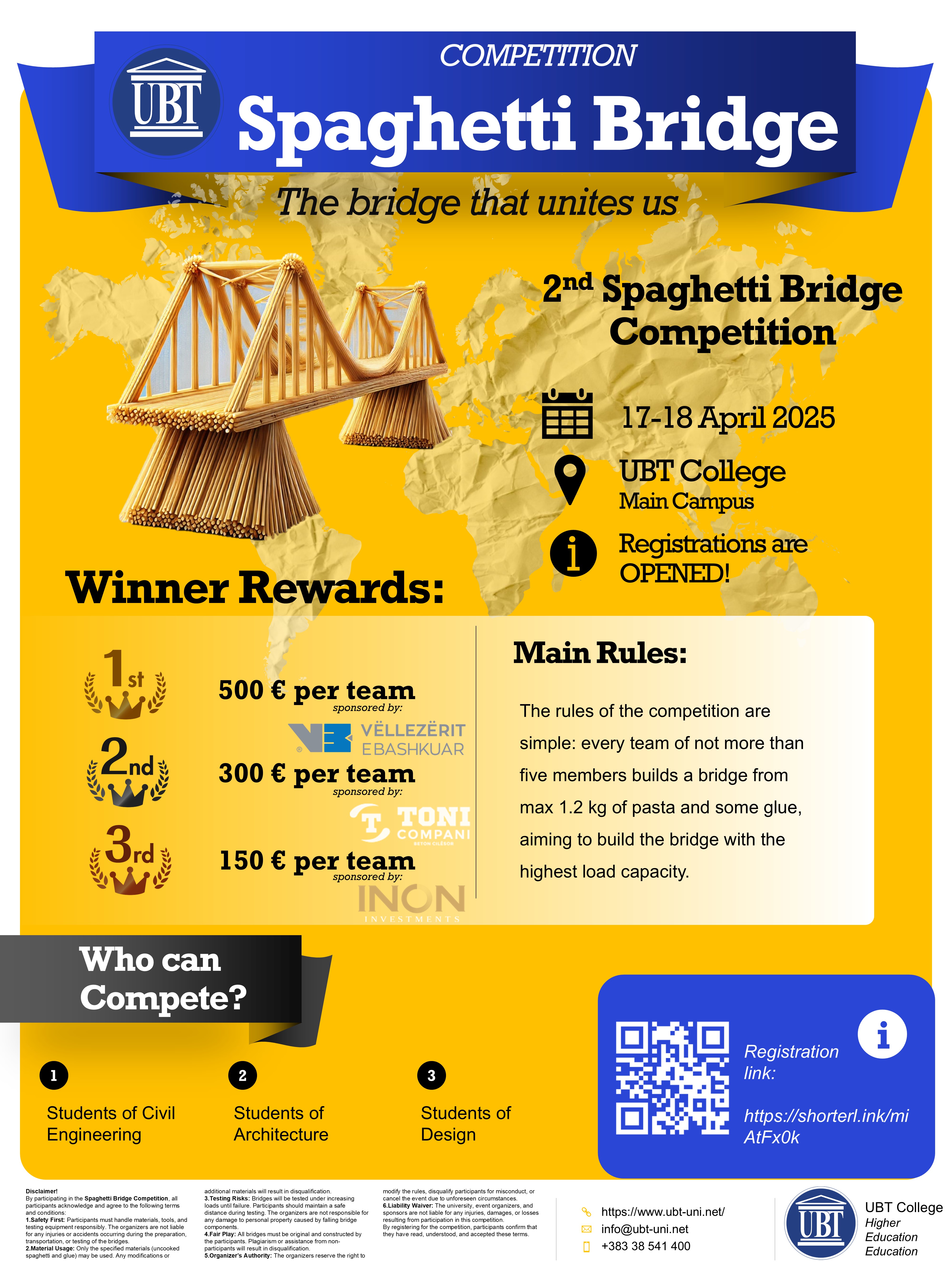
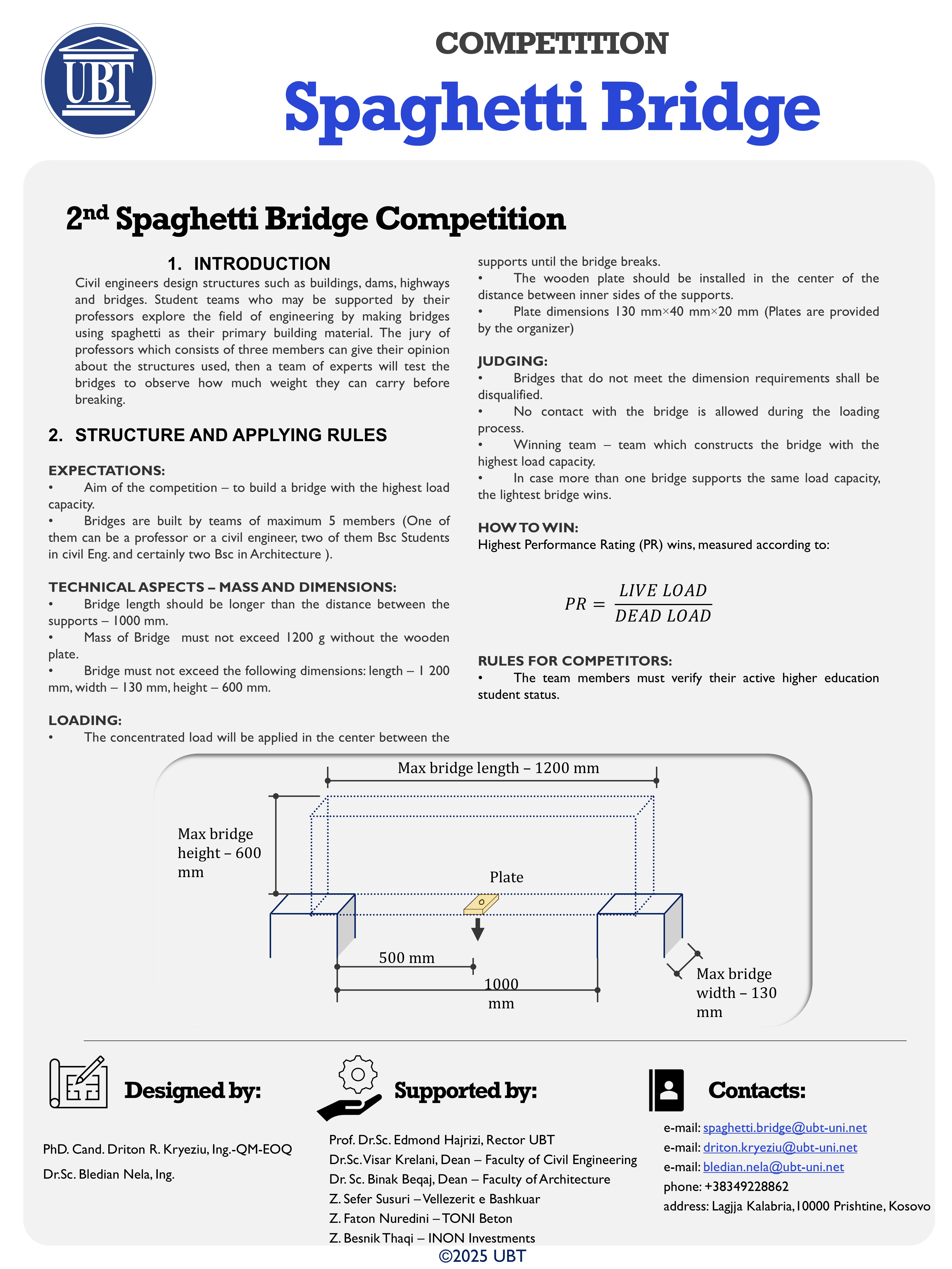
The UBT College, Faculty of Civil Engineering and Infrastructure is excited to announce the 2nd Spaghetti Bridge Competition, a challenge where creativity meets engineering! This thrilling competition invites bachelor students of Civil Engineering, Architecture, and Design from universities in the region to showcase their technical skills by designing and constructing a bridge made entirely of spaghetti and glue.
The Challenge
Participants will form teams of up to five members and use a maximum of 1.2 kg of spaghetti to build a bridge. The goal? To create the strongest bridge possible, capable of withstanding the highest load before breaking. A jury of professors and engineering experts will evaluate the designs and oversee the load testing process.
500 € per team
2nd Place300 € per team
3rd Place150 € per team
UBT College, Main Campus
Dates17–18 April 2025
JudgingThe winning team is the one whose bridge supports the highest load. In case of a tie, the lightest bridge wins.
How to Apply
The competition is open to all bachelor students in Civil Engineering, Architecture, and Design. If you're ready to put your engineering skills to the test, gather your team and sign up now.
Important Rules
- Each team must follow the competition's structural requirements, including bridge dimensions and weight limits.
- Only uncooked spaghetti and glue can be used—no additional materials are allowed.
- Bridges must be longer than 1000 mm and no longer than 1200 mm, with a maximum height of 600 mm and width of 130 mm.
- The concentrated load will be applied at the centre until the bridge collapses.
- Safety first: teams should handle materials and tools responsibly.
Why Participate?
- Test your engineering and design skills in a fun, hands-on challenge.
- Learn from expert professors and industry professionals.
- Network with students and faculty from across the region.
- Win cash prizes and recognition.
Are you ready to build, break, and compete? Take on the challenge of the Spaghetti Bridge Competition.